

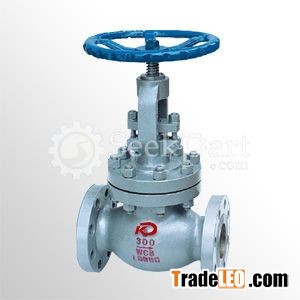
Brand:KAIDONG
1. Scope
This manual covers motor or manually operated screw-down stop valves of different types having nominal size DN15mm~600mm(1/2”~24”) and class PN1.6MPa~16MPa(ANSI CLASS150~900). The valve ends can be threaded, flanged, butt-welded or socket-welded.
2. Application
2.1 Screw-down stop valves are used to open/close the flow in the pipeline.
2.2 The nature of applicable fluid depends on valve material.
2.2.1Carbon steel valves apply to non-corrosive fluid, such as water, vapor or oil, etc.
2.2.2Stainless steel valves apply to corrosive fluid.
2.3 Temperature range:
2.3.1Carbon steel valves -29℃~+425℃
2.3.2Alloy steel valves ≤550℃
2.3.3Stainless steel valves -196℃~+200℃
3. Structure
3.1 Valve structure is shown in Fig.1
3.2 Gasket and packing are PTFE or GRAPHITE. They are used to secure sealing.
4. Operation
Manual valves or motor valves use hand-wheel or electric actuator to open or close the valve by stem and disc rising or moving down. When the drive set moves clockwise the disc moves down to close the valve. When the drive set moves anticlockwise the disc moves up to open the valve.
5. Storage, maintenance, installation and service
5.1 The valve should be stored in dry room with good ventilation. Valve ends should be covered.
5.2 For valves stored for a long period of time, regular checkup is required to ensure that the valves are in good conditions. Foreign particles should be removed and special care should be taken to keep the valves seat sealing face.
5.3 Check the conformance of valve identification to the service requirements prior to installation.
5.4 Check the cleanness of the valve cavity and sealing surface and wipe off any dirt with white cloth prior to installation.
5.5 Before installation, the tightness of packing should be checked to ensure that sealing is secured without affecting the movement of stem.
5.6 The valve shall be in full open position when conducting system or pipeline pressure test after the valve installation.
5.7 Lubricant should be injected regularly to the stem thread while in service.
5.8 Manually operated valve should be operated by using the hand-wheel. Use of levers or other tools is not allowed.
5.9 Valve in service should be examined at prescribed intervals to see whether the wear of sealing surface or stem occurs and the gasket or packing fails. Repair or replacement shall be carried out timely if necessary.
5.10 Electric Valve Actuator Instruction Manual should be referred with regard to the storage, maintenance, installation and service for motor-operated valve.
6. Possible troubles, cause and solution
-1-
Possible troubles, cause and solution
Possible trouble | Cause | Solution |
Leakage through packing | 1.Packing not sufficient pressed 2. Packing failure | 1.Tighten the nut to press packing evenly 2.Replace packing |
Leakage from sealing surface | 1. Some contamination adhered to the sealing surface 2. Damage of the sealing surface | 1.Clean up the contamination 2.Repair or change |
Leakage from middle flange | 1.The body and the bonnet are not joint tightly 2.The sealing surface of middle flange spoiled 3.Gasket is broken or useless | 1.Fix bolts and nuts averagely 2.Repair the sealing surface 3.Change the middle flange gasket |
The hand-wheels cannot turn smoothly or cannot open and close the valve | 1.Packing is pressed too tight 2.Packing gland is deflected 3.The stem nut has damaged 4.The screw thread of the stem nut is destroyed or broken 5. Stem is not straight | 1.Loosen the nuts properly 2.Adjust packing gland 3.Repair the thread and clean contamination 4.Change stem nut 5.Adjust the stem |
Trouble of electric actuator and pneumatic actuator | Refer to Electric Valve Actuator Instruction Manual | |
7. Warranty
The warranty period of valves is one year after coming into service in terms of not beyond 18 months after shipping. During this period if the trouble is caused by the product’s own quality the manufactory will repair it or change the component for free.


