

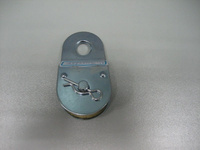
Brand:GV or OEM
Model:GVPL003
Lifting Pulley
1.Capacity:0.5-32t
2.Dia of cable:6-35mm
3.Single,double,triple wheels (open) hook lifting pulley
| Item No. | Material | Surface |
| GVPL001 | Alloy+steel | ZP |
| GVPL002 | Alloy+steel | ZP |
| GVPL003 | Alloy+steel | ZP |
| GVPL004 | Alloy+steel | ZP |
| GVPL006 | Alloy+steel | ZP |
| GVPL007 | Alloy+steel | ZP |
| GVPL008 | Alloy+steel | ZP |
| GVPL009 | Plastic+Steel | Color |
A pulley, also called a sheave or a drum, is a mechanism composed of a wheel on an axle or shaft that may have a groove between two flanges around its circumference. A rope, cable, belt, or chain usually runs over the wheel and inside the groove, if present. Pulleys are used to change the direction of an applied force, transmit rotational motion, or realize a mechanical advantage in either a linear or rotational system of motion. It is one of the six simple machines. Two or more pulleys together are called a block and tackle.
Belt and pulley systems
A belt and pulley system is characterized by two or more pulleys in common to a belt. This allows for mechanical power, torque, and speed to be transmitted across axles. If the pulleys are of differing diameters, a mechanical advantage is realized.
A belt drive is analogous to that of a chain drive, however a belt sheave may be smooth (devoid of discrete interlocking members as would be found on a chain sprocket, spur gear, or timing belt) so that the mechanical advantage is approximately given by the ratio of the pitch diameter of the sheaves only, not fixed exactly by the ratio of teeth as with gears and sprockets.
In the case of a drum-style pulley, without a groove or flanges, the pulley often is slightly convex to keep the flat belt centered. It is sometimes referred to as a crowned pulley. Though once widely used in factory line shafts, this type of pulley is still found driving the rotating brush in upright vacuum cleaners.
Rope and pulley systems
Also called block and tackles, rope and pulley systems (the rope may be a light line or a strong cable) are characterized by the use of one rope transmitting a linear motive force (in tension) to a load through one or more pulleys for the purpose of pulling the load (often against gravity.) They are often included in lists of simple machines.
In a system of a single rope and pulleys, when friction is neglected, the mechanical advantage gained can be calculated by counting the number of rope lengths exerting force on the load. Since the tension in each rope length is equal to the force exerted on the free end of the rope, the mechanical advantage is simply equal to the number of ropes pulling on the load. For example, in Diagram 3 below, there is one rope attached to the load, and 2 rope lengths extending from the pulley attached to the load, for a total of 3 ropes supporting it. If the force applied to the free end of the rope is 10 lb, each of these rope lengths will exert a force of 10 lb. on the load, for a total of 30 lb. So the mechanical advantage is 3.
The force on the load is increased by the mechanical advantage; however the distance the load moves, compared to the length the free end of the rope moves, is decreased in the same proportion. Since a slender cable is more easily managed than a fat one (albeit shorter and stronger), pulley systems are often the preferred method of applying mechanical advantage to the pulling force of a winch (as can be found in a lift crane).
Pulley systems are the only simple machines in which the possible values of mechanical advantage are limited to whole numbers.
In practice, the more pulleys there are, the less efficient a system is. This is due to sliding friction in the system where cable meets pulley and in the rotational mechanism of each pulley.
It is not recorded when or by whom the pulley was first developed. It is believed however that Archimedes developed the first documented block and tackle pulley system, as recorded by Plutarch. Plutarch reported that Archimedes moved an entire warship, laden with men, using compound pulleys and his own strength.
Types of systems
These are different types of pulley systems:
- Fixed A fixed or class 1 pulley has a fixed axle. That is, the axle is "fixed" or anchored in place. A fixed pulley is used to change the direction of the force on a rope (called a belt). A fixed pulley has a mechanical advantage of 1. A mechanical advantage of one means that the force is equal on both sides of the pulley and there is no multiplication of force.
- Movable A movable or class 2 pulley has a free axle. That is, the axle is "free" to move in space. A movable pulley is used to multiply forces. A movable pulley has a mechanical advantage of 2. That is, if one end of the rope is anchored, pulling on the other end of the rope will apply a doubled force to the object attached to the pulley.
- Compound A compound pulley is a combination of a fixed and a movable pulley system.
- Block and tackle - A block and tackle is a type of compound pulley where several pulleys are mounted on each axle, further increasing the mechanical advantage. Block and tackles usually lift objects with a mechanical advantage greater than 2.
How it works
The simplest theory of operation for a pulley system assumes that the pulleys and lines are weightless, and that there is no energy loss due to friction. It is also assumed that the lines do not stretch.
In equilibrium, the total force on the pulley must be zero. This means that the force on the axle of the pulley is shared equally by the two lines looping through the pulley. The situation is schematically illustrated in diagram 1. For the case where the lines are not parallel, the tensions in each line are still equal, but now the vector sum of all forces is zero.
A second basic equation for the pulley follows from the conservation of energy: The product of the weight lifted times the distance it is moved is equal to the product of the lifting force (the tension in the lifting line) times the distance the lifting line is moved. The weight lifted divided by the lifting force is defined as the advantage of the pulley system.


