

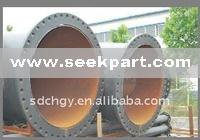
Rubber lined pipe for chemical water transportation
Rubber-Lined Products is that a special production process makes rubber elastomers and metal organic union combine together to form a continuous isolation layer which can prevent medium from being corroded, worn and mechanical impact. Its good anticorrosion performance makesthisproduct can be widely used in electric power, metallurgy, chemical industry, petroleum, coal, cement, etc.
The transfer temperature of rubber-lined products ranges from -30°C to +105°C. Main rubber products include rubber-lined pipes, rubber-lined tanks, rubber-lined chute, and rubber-lined special –shaped fittings, etc. Rubber has two types which are natural rubber and synthetic rubber.
The fine processing technology, complete vulcanized equipment, excellent detection equipment and strict quality control system ensure the high quality of products.
Product Features:
Anticorrosion performance is excellent; this product is resistant to various corrosions, such like oxidizing acid, alkali, salt and so on.
- Good wear-resisting performance. Use life can reach 20 years (theoretical).
- Unvulcanized film is softer, which can be used into different shape liners of matrix. The adhesive strength of Rubber and metal is strong.
- The Rubber is a good elastomer and does not easy to scaling.
- Compared with different anticorrosive products which use other materials, the rubber is light and easy to transport, installation and maintenance. Moreover, the cost is low.
- Connection mode can use flange connection.
- We can produce different shapes of anticorrosive rubber products according to users’ requirement.
The Company’s product solutions enable its customers to address the challenges presented by demanding industrial applications, including:
- Mining, transporting and processing abrasive particles of varying sizes,
- Transporting and processing corrosive materials with varying chemical properties,
- Transporting slurry via pipeline at extreme temperature differences (interior vs. exterior),
- Managing equipment wear performance in light of high velocity transportation,
- Reducing work injury from the installation and maintenance of equipment,
- Maximizing the speed and effectiveness of all mining, transporting and processing functions,
- Minimizing the impact and wear/tear on equipment placed in harsh environments,
- Minimizing the replacement or servicing of wearable equipment and
- Minimizing the use of costly and hard-to-find skilled labor.


