

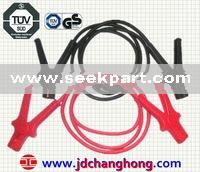
Product name:
Booster cable
- We have been in this area 8 years and the best seller in European market with TUV/GS .
- Quality PVC sheathed copper welding cable gives maximum power transfer yet remains flexible.
- Resistant to oil, grease and most acids.
- Insulated and oversized clamps with strong return springs help reduce the heating effect of power transfer.
- Supplied in re-useable bag with operating guidelines.
- 16mm² x 3mtr.
- 25mm² x 3.5mtr.
- 35mm² x 4.5mtr.
- Heavy-duty.
- PVC sheathed copper cable to maximize power transfer.
- Tough oversize clamps to minimize the heating effect during use.
- We got the TUV/GS certificate.
- Model No. CH/16,25,35/GS
The reason our customers choose :
1) Cross section area: 16mm²,25 mm², 35mm²
Positive & negative symbol marked in clmaps to avoiding incrrect connection.
2)Packing: Handy Zipped Storage Bag, easy to carry
3)Certifications: DIN 72553,TUV/GS
4)How to use?
Instructions:
- 1
Determine that a dead battery is the reason your car is not starting. If the engine cranks when you turn the key, the problem is not the battery and jump-starting won't help. If the windshield wipers, lights and heater blower all work, the battery is probably fine and you may have a bad starter. A jump-start won't help if you have a bad starter. If you hear no sound at all when you turn the key or if the engine cranks very slowly and the accessories do not work, then you have a dead or low battery and it's time to break out the jumper cables. You'll need a flashlight if it's dark outside.
- 2
Find someone with a running car that can give yours a jump.
- 3
Open the hoods on both cars and determine where the batteries are. Park the booster car (the one that's running) so that the batteries are adjacent.
- 4
Turn off the booster car.
- 5
Attach the red jumper cable's end to the positive terminal on the dead battery. Use a rag to wipe the battery clean if you can't see the Pos or plus (+) sign on the battery. The positive terminal is always slightly larger than the negative one.
- 6
Attach the other end of the red cable to the booster battery's positive terminal.
- 7
Attach the black jumper cable's end to the booster battery's negative terminal.
- 8
Attach the other end of the black jumper cable to a ground on the dead car's engine; any solid metal part works fine. You may see a small spark when you attach the last end. This is normal.
- 9
Turn on the booster car and rev the engine.
- 10
Turn on the dead car. If it doesn't start, you may have a poor connection at any of the four cable ends. Jiggle each cable end and try starting the car again.
- 11
once the car starts, disconnect the cables in reverse order of attachment: negative, negative, positive, positive.
- 12
Keep the engine running on the jumped car for at least 20 minutes or longer so the alternator has sufficient time to recharge your battery.


