

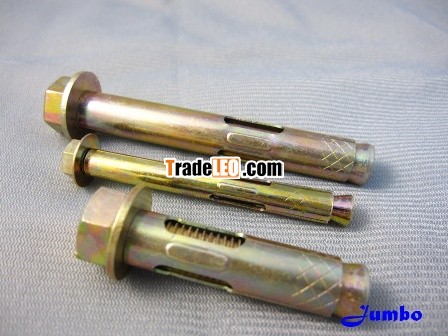
Model:M8 x 10 x 77mm
Features of sleeve anchors:
- Sleeve anchor size is equal to hole size - i.e. a 1/2" sleeve anchor requires a 1/2" hole
- Available in four head styles - hex, round, flat, acorn
- Pre-assembled for faster, easier installations
- Available in diameters from 1/4" to 3/4" and up to 6-1/4" in length
- Available in Zinc plated carbon steel and Stainless Steel
- Provides full 360° hole contact over large area and reduces concrete stress
- Sleeve anchors can be installed through the object to be fastened
- No pre-spotting of holes necessary
- No maximum hole depth
Concrete Sleeve Anchors' design allows them to anchor into concrete, brick and block. Sleeve anchors work by inserting them into a hole drilled into concrete. Turning the nut pulls the working end of the sleeve anchor up through the sleeve, expanding and anchoring itself securely in the concrete, brick or block。
Sleeve Anchors — Installation Instructions
The installation of a sleeve anchor can be completed in a series of simple steps as described below. It is helpful to note that hole diameter is always equal to the sleeve anchor diameter, and, furthermore, hole tolerance is crucial to the sleeve anchor's performance. To achieve the proper hole, it is important to use a hammer drill with a carbide-tipped masonry bit. These bits are specifically designed for use in hammer drills and meet the necessary ANSI standards. Installation steps are as follows:
- Using the hole of the fixture as a template, carefully drill your hole using a hammer drill and carbide-tipped masonry bit. The drill bit diameter should be the same diameter as the sleeve anchor. Hole depth should be 1/2" to 1" deeper than anchor embedment.
- Clear the hole of all debris using compressed air, a shop-vac or wire brush.
- Set nut flush with the top of the anchor.
- Drive the sleeve anchor through the fixture to be fastened into the hole in the base material, ensuring that they are installed to the desired depth.
- Tighten all nuts using a wrench (hex/acorn) or screwdriver (flat/round) making certain that they are tightened to the required torque value.


