

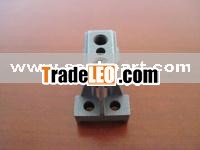
Brand:Hengrui
Model:HR308
metal Injection Molding Applications
- Automotive Systems - Steering Columns (actuators, ignition lock components), Sun Roofs (stop cams), Seating Mechanisms, Solenoids, Fuel Injectors
- Orthodontics – Brackets, Buccal Tubes
- Medical and Dental Instruments – Endoscopic Surgical Instruments
- Firearm Components – Triggers, Sights, Safeties, Seer Blocks
- Ordnance – Guidance Fins
- Hardware and Lock Parts – Lock Cylinders, Bolts, and Sidebars
- Computers and Electronics – Disk Drive Components
- Electrical – Connectors, Switches
metal Injection Molding (MIM) Process
The metal Injection Molding process is a multi-stage process that converts fine metal powders into near full density, high strength metal components. MIM competes with cast, wrought, and machined metal components on the basis of both manufacturing cost effectiveness and material properties. The process consists of mixing fine metal powders with thermoplastic binders to form a feedstock which is injection molded into a closed mold. After ejection from the mold, the thermoplastic "binders"are chemically or thermally removed from the part so that the part can be sintered to high density. During the sintering process, the individual particles metallurgically bond together as material diffusion occurs to remove most of the porosity left by the removal of the binder. The sintering process shrinks the part, providing a net shape that can be used as-is or further worked to add additional features or improve tolerances.
Mixing
metal Injection Molding feedstock begins with micron-sized metal particles. The metal powders are hot mixed with thermoplastics chosen to provide the necessary rheological properties for molding, mechanical properties for handling, and chemical and physical properties for ease of subsequent binder removal. Good feedstock formulations balance numerous conflicting cost and processing factors relating to both powder and binder selection.
Molding
Standard plastic injection molding machines are used to form metal Injection Molding components. The feedstock is heated in the barrel to soften the powder/binder feedstock to a toothpaste consistency. This hot paste is injected into a closed mold cavity and cooled prior to ejection. Robotic pick-off is typically used to prevent handling damage. Runners and gates are reground and reused, minimizing scrap loss at the molding operation.
Debinding
once the part is molded, the thermoplastic binders used to help the powder flow into the die are no longer needed and must be removed. First, a portion of the binder is removed to open up a pore network within the part. The remaining binder is subsequently removed through the open pore network that has been created. This two-stage process removes the binder without creating internal cracks or voids within the part. There are several effective binder removal methods in commercial practice, both thermal and chemical, each with its own set of advantages and limitations.
Benefits of the metal Injection Molding Process
The benefits of the metal Injection Molding process are best realized by considering the metal Injection Molding manufacturing process during the initial design stage of the parts or assembly. The primary benefits include:
- Design Freedom - MIM offers design flexibility similar to plastic injection molding. Geometrically complex parts that cannot be produced using the conventional powder metal processes without secondary machining are possible using the MIM process.
- Enhanced Details - MIM provides intricate features such as dovetails, slots, undercuts, threads, and complex curved surfaces. MIM can produce cylindrical parts with greater length-to-diameter ratios.
- Reduced Assemblies – The MIM process can be used to combine two or more simpler shapes into a single, more complex component to minimize assembly costs.
- Reduced Waste/Machining - MIM's capability to provide net shape components eliminates many secondary machining operations.
- Improved Properties - MIM parts are typically 95% to 98% dense, approaching wrought material properties. MIM parts achieve greater strength, better corrosion resistance, and improved magnetic properties when compared to conventional powder metallurgy processes.
Customers requiring mechanical properties exceeding those available with plastic injection molded or die cast materials are turning to MIM. metal Injection Molding also provides a cost-effective, automated alternative to the labor-intensive investment casting process. With highly complex geometries available, MIM is an effective alternative to complex machined components or intricate assemblies.
metal Injection Molding excels at producing small, complex components that require thin, uniform cross sections (up to .250 inch). Thicker sections are typically limited by the high cost of the raw material, the difficulties involved in molding defect-free thick sections, and the ability to remove the binders effectively from the molded parts.
The economics of the MIM process favors higher annual part volumes. Although MIM can be a cost-effective solution for small, complex parts at lower volumes, the cost of molding tools discourages lower volume applications.


