

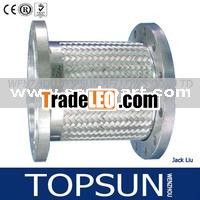
metal bellows are elastic vessels that can be compressed when pressure is applied to the outside of the vessel, or extended under vacuum. When the pressure or vacuum is released, the bellows will return to its original shape (provided the material has not been stressed past its yield strength).
Applications
Vacuum interrupters: For the switching of very high voltages in transformer stations sparks should be avoided. To prevent any danger that the surrounding atmosphere will explode, oxygen has to be removed in the area where the sparks occur. This can be done by sealing the spark area completely. Bellows are used to seal such confined volumes and the inside of the bellows is evacuated or filled with an inert gas.
Mechanical Seals: These are mostly used to close the inside of a pump from the outside world to prevent leakage. For that purpose, a mechanical seal is mounted on the pump shaft. As the pump shaft is turning, there has to a rotating sealing element consisting of a stationary and a rotating ring. To enforce sufficient pressure on the two rings one is fitted with a spring. This spring can also have the form of a diaphragm (welded) bellow.
Exhaust Bellows: Running engines cause self vibration. To compensate for those movements and temperature differences resulting in thermal expansion, bellows are used to connect the exhaust gas pipes to the funnel.
Piping expansion joint: In this application, bellows are formed in series to absorb thermal movement and vibration in piping systems that transport high temperature media such as exhaust gases or steam.


