

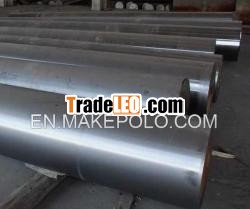
Brand:Unite Steel
MOQ:5
Quantity:10000
X9931/1.6743/32NiCrMo104/826M31/EN25
Description: EN25 is a 2.5%nickel - chromium - molybdenum high hardenability, high tensilesteel, generally supplied hardened and tempered in the tensilerange 930 - 1080 Mpa (Condition U) Rc 28 - 36.
Characterised by high strength and toughness in very large sections- similar to EN26 but with lower carbon content.
Pre hardened and tempered EN25 can be further surface hardened byflame or induction hardening, and by nitriding.
EN25 is used extensively in most industry sectors for applicationsrequiring higher tensile and yield strength than 4140 canprovide
APPLICATIONS:
X9931 is suitable for the most severe duties where freedom fromtemper brittleness is necessary. It has high strength and toughnessin large sections. Applications include heavy drive shafts, axles,gears, excavator pins, automotive, and general, engineeringapplications, such as Shafts, connecting rods, pump and gearshafts, Die Holder Blocks, and long wall coal mining roof supportpins.
RELATED SPECIFICATIONS:
Australia AS 1444-2007 X9931
Germany W.Nr 1.6743 32NiCrMo10 4
Great Britain BS970: Part 3: 1991 826M31
BS970: 1955 EN25
Chemical Composition %:
Carbon 0.37-0.44
Silicon 0.17-0.37
Manganese 0.50-0.80
Phosphorus 0.04 max
Sulphur 0.04 max
Chromium 0.60-0.90
Molybdenum 0.15-0.25
Nickel 1.25-1.85
Process: EAF+LF+VOD+Forged+HeatTreatment(optional)
SIZE RANGE:
Round:
Hot Forged: 80mm-1200mm
SURFACE FINISHES:
Black, Peeled K12, Cold Drawn, Turned & Polished H10, H11,Precision Ground H9, H8
Test: Ultrasonic testaccording to SEP 1921-84 3Cc
Forging
Heat to 1150 oC - 1200 oC maximum, hold until temperature isuniform throughout the section.
Do not forge below 850 oC.
Following forging operation the work piece should be cooled asslowly as possible in sand or dry lime etc..
Heat Treatment
Annealing
Heat to 800 oC - 850 oC, hold until temperature is uniformthroughout the section and cool in furnace.
Flame or Induction Hardening
EN25 hardened and tempered bar can be further surface hardened byeither the flame or induction hardening methods resulting in a casehardness of Rc 50 approx. Parts should be heated as quickly aspossible to the austenitic temperature range (830 oC - 850 oC) andrequired case depth followed by an immediate oil or water quench,depending upon hardness required, workpiece size/shape andquenching arrangements.
Following quenching to hand warm, most components should betempered between 150 oC - 200 oC to remove quenching stresses inthe case. This will have little effect on case hardness.
Hardening
Heat to 830 oC - 850 oC, hold until temperature is uniformthroughout the section, soak for 10 - 15 minutes per 25 mm ofsection, and quench in oil, water, or polymer as required.
*Temper immediately while still hand warm.
Nitriding
EN25 hardened and tempered bar can also be successfully nitrided,giving a surface hardness of up to Rc 60. Nitriding is carried outat 490 oC - 530 oC, followed by slow cooling (no quench) reducingthe problem of distortion. Parts can therefore be machined to nearfinal size, leaving a grinding allowance only. The tensile strengthof the core is usually not affected since the nitriding temperaturerange is generally below the original tempering temperatureemployed.
N.B. Nickel is inert to the action of nitrogen and in generalresists its diffusion into steel, and this can result in a lowercase hardness or longer nitriding cycle times for steels containingnickel such as EN25.
Stress Relieving
Heat to 640 oC - 660 oC, hold until temperature is uniformthroughout the section, soak for 1 hour per 25 mm of section, andcool in still air.
Tempering
Re-heat to 450 oC - 660 oC as required, hold until temperature isuniform throughout the section, soak for 1 hour per 25 mm ofsection, and cool in still air.
N.B.Tempering should be avoided if possible within the range 250 oC- 450 oC due to temper brittleness.
Notes on Heat Treatment
Heating temperatures, rate of heating, cooling and soaking timeswill vary due to factors such as work piece size/shape also furnacetype employed, quenching medium and work piece transfer facilitiesetc..
Machining
EN25 in the hardened and tempered as supplied condition is stillregarded as being readily machinable and operations such as turningand drilling etc. can be carried out satisfactorily using machinemanufacturers, recommendations for suitable tool type - feeds andspeeds.
Welding
Welding of EN25 in the hardened and tempered condition (as normallysupplied), is not recommended and should be avoided if at allpossible, as the mechanical properties will be altered within theweld heat affected zone. It is preferred that welding be carriedout on EN25 while in the annealed condition, and that the workpiece, immediately on cooling to hand warm, is then stress relievedat 640 oC - 660 oC prior to hardening and tempering.
If welding in the hardened and tempered condition is reallynecessary, then the work piece, immediately on cooling to handwarm, should be if possible stress relieved at 15 C below theoriginal tempering temperature (if known).
Welding Procedure
Welding of EN25 in whatever condition should always be carried outusing low hydrogen electrodes
Certificate ofQuality: issued in English, in additionthe normal terms, production process, the mechanical property yieldstrength, tensile strength, elongation and hardness, forged ratio,UT test result, Grain size, heat treatment methods and the sampleof is shown on the Certificate of Quality.
Marking: Heat No. will becold stamped and Steel grade, diameter mm, length mm, and themanufacturer LOGO and weight kg is painted


