

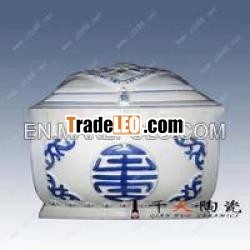
Brand:Tanglong Ceramics
MOQ:1
High-quality PorcelainUrns
Funerary urns (also called cineraryurns and burial urns) were used by manycivilizations. After a person died, survivors cremated the body andcollected the ashes in an urn. Pottery urns, dating from about7000 BC, have been found in an early Jiahu site in China, wherea total of 32 burial urns are found,and another early finds are inLaoguantai, Shaanxi. There are about700 burial urns unearthed over the Yangshao(5000–3000 BC) areas and consisting more than 50 varieties ofform and shape. The burial urns were used mainly for children, butalso sporadically for adults. In ancient Greece, the lekythos, a typeof pottery inancient Greece, was used for holding oil in funerary rituals.In the Bavarian tradition, aking''s heart would be placed in the urn upon his death (ashappened with King Otto of Bavariain 1916). Cremation urns were also commonly used in Anglo SaxonEngland.
Romans placed theurns in a niche in a collective tomb called a columbarium(literally, dovecote). The interiorof a dovecote usually has niches to house doves.
The discovery of a Bronze Age urn burialin Norfolk,England prompted Sir Thomas Browne tocarefully describe the antiquities found. He expanded his study tosurvey burial and funerary customs, ancient and current, andpublished it as Hydriotaphiaor Urn Burial (1658).

