

Description:
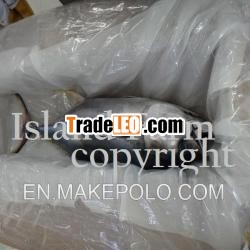
Frozen yellow Fin Tuna
Fresh frozen yellow fin tuna of sizes 5-50kg.
English: Yellowfin Tuna.
Latin: Thunnus albacores.
Around the world:
36% Western Pacific
26% Eastern Pacific
24 % Indian Ocean including Maldives
14% Atlantic Ocean
Major Markets of Maldives: USA, Europe, Japan, Thailand andSrilanka.
International Markets: Japan, Western-Europe, United States.
Major products of Maldives: Chilled whole fish, Frozen Loins,Chilled Loins.
Production of Other countries: Canned, Chilled whole fish,Frozen Loins, Chilled Loins, Fresh Fillets, Smoked.
Yellow fin tuna is caught in abundance each year in Maldives.Commercially it is a very important Fish in Seafood and FishingIndustry of Maldives. A huge amount of it is exported to variouscountries such as USA, Europe, Japan, Thailand and Srilanka .As aresult, a good amount of income is generated to the country byexporting it.
Probably, its name is derived by the color of the second dorsalfin and the anal fin, having bright yellow color. The pectoral finsare very long and its back is very dark metallic blue and graduallythe color fades to silver in the area of belly. And in the bellyyou will find approximately 20 beautiful horizontal lines.
It is a Fast runner which can cover a huge distance around theworld within hours and they have companions accompanying with themlike Dolphin, whales, whale sharks, they are found between 45oN and40oS.As most of Tuna families the feed on other fish , crustaceans,squids and cuttlefish.
One of the habits of this fish is that it schools with the samesize of fishes. That’s why during fishing same size fishes arecaught.
Maldives law prohibits the use of Nets to fish to preserve thelive stock of the Ocean which only a few countries around the globeadopt. Allowed methods are pole and line, Trolling, Long linefishing and using fishing lines with free hand. It is real fun tocatch it with rod and reel because of its strength and speed.
It is a very famous Protein rich food source you will find inmany Maldives and world wide Restaurants. Its flesh is dark red incolor which looks like red meat. Recipes of Tuna are fine andtasty; a very famous food for the Japanese table, Sashimi andSushi. Great dishes of it are prepared by Grilling, Barbecuing,Shallow and deep Frying and by Smoking.
Maldives Tuna is quite different from other parts of the worlddue to high percentage of salinity around the small islands ofMaldives whish is scattered in the middle of Indian Ocean. We havesea ( 98% ) more than land. Therefore, Maldives fish makes adifference from others.
Our prices are competitive with a low margin & profit isbased on continuous supply with trust, to create a long termbusiness relationships with our buyers. We are also controlling thevolume in order to keep the quality and standard of our fish, inline with internationally accepted qualities.
We encourage our buyers to use air freight to keep the qualityof fish unaffected. We can supply our products, to any parts of theworld by Sea or Air Freight depending on the season.
Our People
Our fishermen’ s are well trained and qualified in Yellow FinTuna fishing. Albeit they use traditional pole and line method tocatch, and they are equipped with the state of the art equipmentsto trace the catch.
CANNED TUNA
General description
Canned tuna is specified as Premium, Fancy, Standard, and localpack. In addition we have Sauce Tuna, and Caters pack.
All the above canned products are manufactured from cooked tunafish, which is skinned, headed, eviscerated, trimmed of all bloodmeat and scorched and packed with a covering of oil or brine inhermetically sealed can and sterilized to achieve commercialsterility by application of heat.
Raw Material
The species used for manufacture of canned tuna are KatsuwonusPelamis “ Skipjack” and Thunnus Albacares “ Yellow fin tuna” . Thefish used in manufacture are whole, fresh, chilled or frozen.
Water
The water used as water, or water used to make brine is potablewater.
Vegetable Oil
For canning purpose the oil we used is depending on buyer’ spreference. We use vegetable oil; soy bean, sunflower oil, andolive oil as a base for our tuna chunks.
Salt
Food grade salt is used.
Can size
We use 7oz cans ( 2 piece) and 4lbs cans ( 3 piece)
Package
The following styles of packing are offered:
Standard 48 can carton
4 pack ( 4 x 12)
4 pack ( sticker and sleeve)
3 pack ( 3 x 46 card board sleeve)
Tray pack ( 2 x 24)
Tray pack 24
Tray pack 12
Hooded carton
FROZEN TUNA
Processing method
The fish is treated by Blast or brine freezing method.
Our frozen species are Katsuwonus Pelamis “ Skipjack” andThunnus Albacares “ Yellowfin” tuna.
The size categories offered:
Yellow fin
9kg – 12kg
12kg – 20kg Gill and Gutted
20kg – 40kg Gill and Gutted
40kg and above Gill and Gutted
Skip Jack
7.5 – 20lbs
7.5lbs up
4 – 7.5lb
3 – 4lbs
0 – 3lbs
FISH MEAL
Fishmeal, a fertilizer as well as an essential ingredient inpoultry, and fish feed, this is by product of the Cannery.
To reduce amount of waste exhausted from fish products, fishmeal is produced from the waste fish from the Cannery
KATUSOBISHI
Katuobushi is the Japanese name for a specific type of smokeddried tuna. Although Katuobushi is a form of dried skipjack, theproduct may be said to be similar to the traditional Maldive Fish.However, the process of smoke drying which lasts for 21 days at aminimum as opposed to less than a week’ s drying for normal smokedskipjack means that Katuobushi is much drier, therefore a betterpreserved product. Quality of the product is maintained by usingspecially imported wood from Japan at specific stages of smokingand by using Refrigerated Containers for shipping the finishedproduct.
Individual processes fine-tune the processing cycle to suit theextreme end of the niche market by supplementing the drying andsmoking stages with custom processes, using humidifiers anddifferentiated packaging.
Japanese Katuobushi processors prefer skipjack caught in theMaldivian waters because of lower fat content. only the best of theharvest, preferably when landed with ice or in the morning isaccepted by the quality conscious processors as raw material fortheir plants.
Japanese technical know-how is fully used with the pick ofquality from the Maldivian Skipjack Industry.
FRESH YELLOW FIN TUNA
Lions: Half cut, Center cut Yellow Fin tuna loins ; Can be fullloins without tail piece
Size: 2 - 4 kg per piece
Quality: Sashimi Grade, A Grade with strong texture freshwrapped in plastic bag
Treatment: Untreated
Individual packing: vacuumed ( poly bag)
Master carton: Polystyrene box 20 - 30 kg cooled with gel Ice& Labels on loins and on boxes
Yellow fin tuna whole ( chilled and frozen) , instant vacuumpacked, lions etc. we also prepare the products to customer’ sspecifications.
FROZEN YELLOW FIN TUNA
Frozen/ chilled yellow fin, gilled and gutted, are exportedindividually cleaned and packed in master card board boxes with gelice packets.
Size: 20.0kg UP per piece
Our Commitment to quality
We have selected the area where it is best situated to competewith other producers of fish related products: - environmentallysustainable, quality production. Priority has always been given toensure health, hygiene and quality standards are met, for thesafety and satisfaction of our customers. Our factories adhere torelevant international standards including HACCP, EU approval, ISO,BRC Global Standard and Laboratory Accreditation. We continue itscommitment to the belief and leads in competitiveness throughQuality than quantity or price.
QUALITY AT EVERY STAGE
The primacy of Quality in, reflect a deep-held corporate beliefthat national competitiveness would be sustained through Qualityrather than through quantity or price. This belief is well embeddedin the management structure of the company and its marketingphilosophy and has meant that all our processing establishments areEU approved and that our’ products have enjoyed and continue toenjoy a reputation for Quality in all our major Markets. We havetaken this process a step further at FFC and at KFV by getting ourlaboratories accredited by “ Camp den Laboratory AccreditationScheme” ( CLAS, UK) , their processes with Grade A against BRCGlobal Standards ( Food) accredited by European Food SafetyInspection Services ( EFSIS, UK) . Additionally FFC has moved theextra step by maintaining its Quality Management System to ISO9001: 2000 standard. We look to continually improve its qualitysystems by expanding such achievements to all our operationalcenters.


